SketchUp Version Compatibility & Format Evolution: The Complete 2026 Reference Guide
Which SketchUp version opens which .skp file? A complete encyclopedic guide to the 2000–2027 evolution, the unified container schema, binary header tokens, Trimble's 3-year support policy, and industry downgrade matrices.
Version mismatch errors are the leading operational bottleneck in digital architectural workflows. Project managers, lead architects, visualization artists, and fabrication shops regularly ask:
- "Why does my SketchUp 2021 setup reject a model sent by a consultant using 2024?"
- "Why have 2017 and 2020 format choices completely disappeared from the desktop Save As dialog?"
- "Does Trimble introduce an isolated format every year, or do modern releases share a common schema?"
- "Which target year should I select when exporting deliverables to downstream contractors?"
In reality, SketchUp does not introduce a completely isolated proprietary format every calendar year. Navigating version compatibility requires mastering two historical eras and two foundational rules.
Disclaimer & Trademark Notice: SKPDowngrade operates independently and is not affiliated with Trimble Inc. SketchUp is a registered trademark of Trimble Inc. Support policy dates referenced reflect Trimble's desktop lifecycle policies.
1. Two Foundational Compatibility Rules: Pre-2021 vs. Post-2021
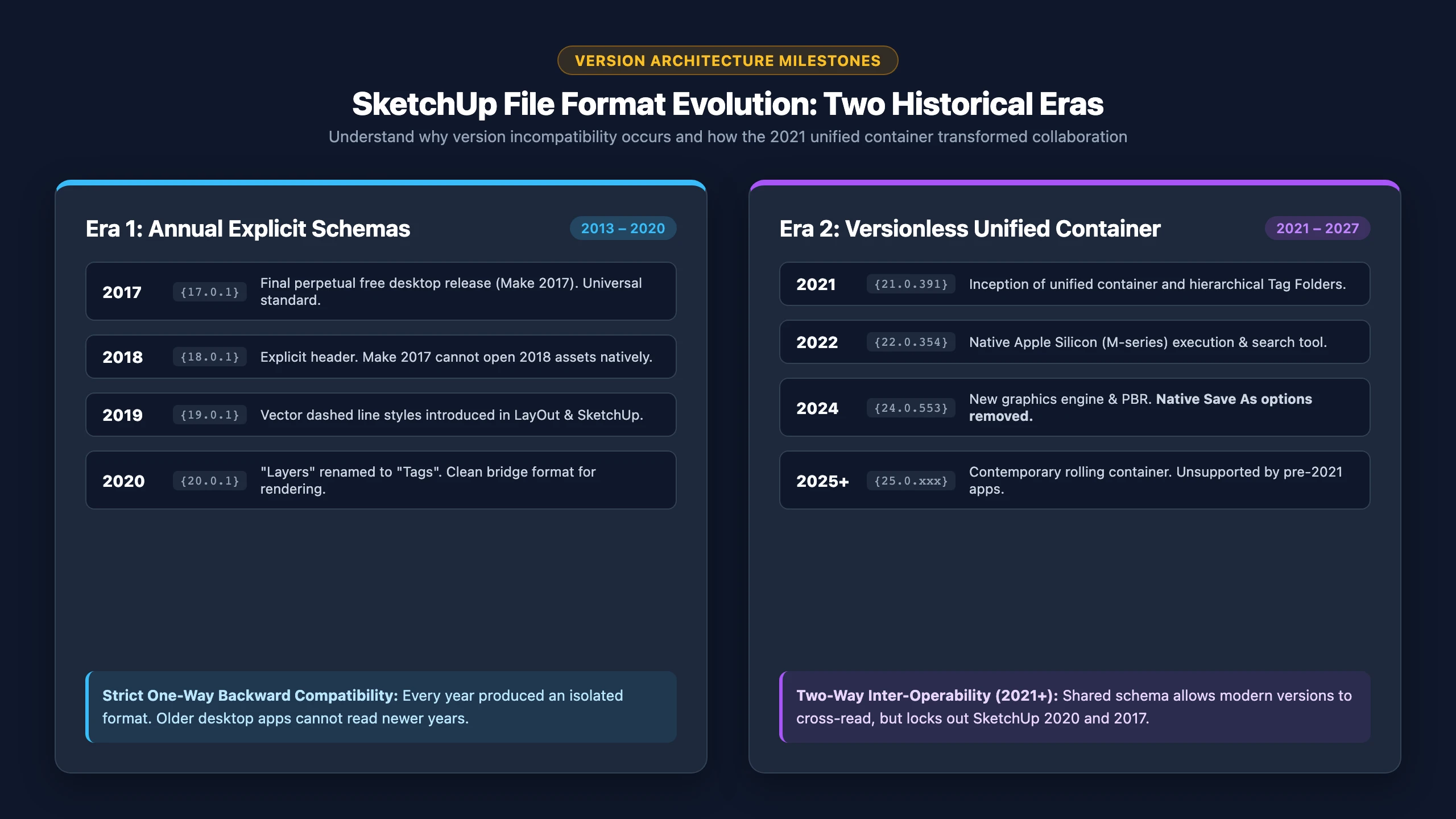
Throughout SketchUp's 20-plus-year trajectory, file format evolution falls into two distinct paradigms:
Rule 1: The 2013–2020 Era (Annual Explicit Formats, Strictly One-Way Backward Compatibility)
- Underlying Architecture: Every annual release wrote an explicit, dedicated annual header signature into the file (e.g.,
{17.0.1}for 2017,{20.0.1}for 2020); - Behavior: Newer software opens its own year and all prior historical files. However, older software strictly cannot decode newer schemas. For example, SketchUp 2018 opens 2017 assets smoothly, but SketchUp 2017 halts with a "Created in a newer version" error when given a 2018 file;
- Native Export: During this era, desktop
File > Save Asfully supported selecting older release years from the format drop-down list.
Rule 2: The 2021–2027 Era (Versionless Unified Container Schema)
- Underlying Architecture: Starting with SketchUp 2021, Trimble discontinued annual isolated file schemas, standardizing on a "Versionless Unified Container";
- Behavior: Files saved in 2021 and later can theoretically be opened across 2021–2027 installations. When an older release (such as 2021) opens a model authored in 2024, 2025, or 2026, it skips newer unsupported attributes (such as PBR maps) and may display a soft version warning. This notice is normal and does not signify file corruption;
- Hard Isolation from Pre-2021: The unified container creates a hard boundary with 2020 and earlier releases. SketchUp 2020 lacks the archive decoders required to parse unified containers and will always reject any 2021+ file.
2. Complete Version Compatibility Matrix
| Saved In | Readable By | Blocked In | Characteristics & Recommended Action |
|---|---|---|---|
| SketchUp 8 & Older | SketchUp 8 and all newer editions (including Make 2017) | Ancient releases prior to the file's build | Early legacy format; opens natively across modern suites |
| SketchUp 2017 | SketchUp 2017 and all newer editions | 2016 and older | Carries explicit {17.0.1} header; universal benchmark |
| SketchUp 2018 | SketchUp 2018 and all newer editions | SketchUp 2017 and older | Carries {18.0.1} header; convert via 2018 to 2017 Pipeline |
| SketchUp 2019 | SketchUp 2019 and all newer editions | 2018 and older | Carries {19.0.1} header; convert via 2019 to 2017 Pipeline |
| SketchUp 2020 | SketchUp 2020 and all newer editions | 2019 and older | Carries {20.0.1} header; Layers renamed to Tags; 2020 to 2017 Pipeline |
| SketchUp 2021 ~ 2027 | 2021 and newer (shared unified schema) | SketchUp 2020 and older | Modern unified container era. Must downgrade to 2020 or 2017 for legacy recipients |
Key Rule: Selecting 2021, 2022, 2023, 2024, or 2025 in the SKPDowngrade converter outputs the modern unified container format. It is not an isolated annual schema. If your recipient is running SketchUp 2020 or 2017, explicitly choose 2020 or 2017 as your conversion target.
3. Decoding Binary File Header Signatures
The first 512 bytes of a .skp file contain the version token. Using our Free SKP Version Detector, you can inspect this signature entirely client-side:
| Header Signature | Internal Interpretation | Compatibility & Behavior Notes |
|---|---|---|
{8.0.1} | SketchUp 8 (Legacy Era) | Make 2017 and all newer editions read natively |
{17.0.1} | SketchUp 2017 | Explicit legacy header; native Make 2017 format |
{18.0.1} | SketchUp 2018 | Explicit header; Make 2017 cannot open |
{19.0.1} | SketchUp 2019 | Explicit header; 2018 and older cannot open |
{20.0.1} | SketchUp 2020 | Explicit header; Layers officially renamed to Tags |
{21.0.391} | SketchUp 2021 | Unified container inception; introduces Tag Folders |
{22.0.354} | SketchUp 2022 | Unified container; native Apple Silicon support |
{23.0.xxx} | SketchUp 2023 | Unified container; revised Flip and modeling tools |
{24.0.553} | SketchUp 2024 | 24 indicates release year; 553 is build. New graphics engine |
{25.0.xxx} ~ {27.0.xxx} | SketchUp 2025 ~ 2027 | Contemporary unified schema; shared foundational structure |
Quick Formula: Between 2013 and 2020, adding 2000 to the leading number yields the calendar year (17 is 2017, 20 is 2020). From 21 onward, the number represents the annual build generation within the unified container era rather than an isolated format requiring inter-conversion.
4. Key Version Milestones & Architectural Shifts
- SketchUp Make 2017 (Final Perpetual Free Release):
- The final free perpetual desktop version released by Trimble;
- Featuring a robust 64-bit architecture, it remains an everyday workhorse across academic labs, maker spaces, and woodworking shops.
- SketchUp 2020 (The Tag Transition):
- Formally transitioned "Layers" to "Tags" and enabled independent object hiding in the Outliner;
- Its explicit
{20.0.1}header serves as the premier bridge between modern containers and legacy environments.
- SketchUp 2021 (Container Unification & Tag Folders):
- Introduced hierarchical Tag Folders for organizing large assemblies, alongside the versionless unified container;
- Laid the foundation for smooth cross-reading among modern subscription releases.
- SketchUp 2024 (Graphics Overhaul & Save As Lockout):
- Overhauled the viewport rendering engine with Ambient Occlusion (AO) and PBR materials;
- Critical Milestone: Trimble completely removed older annual options from desktop
File > Save As, ending native backward export.
5. Trimble End-of-Support Policy (The 3-Year Window)
Users frequently conflate official vendor support with file format readability:
- Support Policy Scope: Trimble enforces a "Three-Year Support Policy", officially supporting the current desktop release plus the preceding two major annual versions for bug fixes, patches, and 3D Warehouse/Extension Warehouse cloud integrations;
- Currently Supported Desktop Editions: SketchUp 2025, 2026, and 2027. SketchUp 2024 and earlier are officially unsupported;
- Policy References: Trimble documents these policies on its Official End of Support Policy Page;
- Unsupported ≠ Unreadable: An unsupported application like SketchUp Make 2017 continues to launch and reliably open 2017 format files. Support policies govern official assistance and web service access; file readability is dictated strictly by container compatibility.
6. Industry-Specific Recommendations for Target Years
When preparing deliverables for external distribution, follow these industry guidelines:
| Industry Sector | Typical Downstream Toolchain | Recommended Target | Core Reasons & Pitfalls to Avoid |
|---|---|---|---|
| Architectural Visualization | Lumion 10–12, V-Ray, D5, Enscape | Target 2020 or 2017 | Importers have undergone a decade of refinement; eliminates crash-to-desktop events and UV scaling distortions |
| Millwork & CNC Fabrication | Cabinet fabrication plugins, nesting engines | Target 2020 | Retains single-level tags, component definition axes, and joinery cuts cleanly |
| Structural & Detailing | AutoCAD, Revit, Tekla interfaces | Target 2017 or 2020 | External CAD/BIM parsers have highest tolerance for 2017 B-Rep geometry |
| Client Concept Reviews | Generic office PCs, conference projectors | Target 2017 | Guaranteed instant opening across non-specialist hardware |
| Academic Computer Labs | University lab images (2017/2020 dominant) | Target 2017 | Bypasses frozen system images and student critique projection hurdles |
| Civil & Landscape Design | Terrain modeling plugins, GIS importers | Target 2020 | Preserves georeferencing coordinates, solar north angles, and contour meshes |
| Exhibition & Staging | 3ds Max production teams | Target 2020 | Allows efficient polygon merging by material in 3ds Max without mesh fragmentation |
| BIM Digital Twins | Proprietary digital twin platforms | Target 2020 | Retains clean entity hierarchies and instance naming for attribute mapping |
Facing a version hurdle? Check your file's build signature with our Free SKP Version Detector, or browse our Version Conversion Directory to generate your compatible copy!